
Investing serves as a vital tool for wealth accumulation and achieving financial security. For individuals exploring how to start investing in Malaysia, understanding the fundamentals is an important first step. In this article, let’s examine the various types of investments available, their significance in promoting financial growth, and the advantages of initiating investment activities early, which is often emphasised in a beginner’s guide to investing.
Before making any investment moves, key factors to consider include defining your financial objectives and assessing your risk tolerance. Furthermore, this discussion will provide insights into different investment methodologies, investment basics in Malaysia, strategies for portfolio construction, and common pitfalls to avoid, including common investing mistakes.
Whether you’re a novice or seeking to enhance an existing investment strategy, this guide aspires to facilitate a successful investment journey by explaining how to invest money in Malaysia in a structured and informed manner, making it relevant for first time investors as well as those refining their understanding of investment options in Malaysia.
What is Investing?
Investing is the act of allocating resources, usually money, with the aim of growing its value over time, rather than keeping it idle. In the context of how to begin investing in Malaysia, investing typically involves placing money into financial instruments that have the potential to generate returns over the short or long term. For beginners, it can seem daunting, but understanding the basics of investment options—such as stocks, bonds, unit trusts, and ETFs—can pave the way for effective personal finance management and long-term financial growth, which are essential steps to start investing.
However, it’s vital to remember that risk and returns are intertwined in the investment world. Investments come with varying degrees of risk and return, requiring careful consideration before committing funds as there is no one-size-fits-all approach when deciding how to start investing in Malaysia. Ensuring that your investment choices align with your financial goals and risk tolerance is an important part for those exploring investment for the first time.
What are the Different Types of Investments?
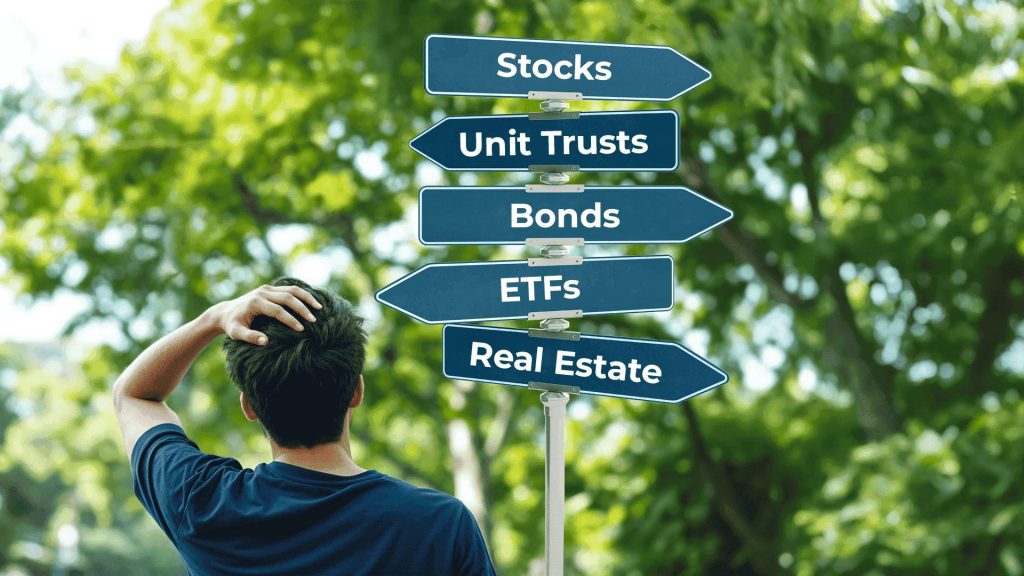
Different types of investments include stocks, bonds, unit trusts, exchange-traded funds (ETFs), and real estate, each offering unique benefits and risks for beginners, and are among the best investments for beginners. Understanding these investment options in Malaysia can help beginners make sense of how to start investing in a more structured way.
Navigating the diverse landscape of investment options for beginners can be both exciting and daunting. Each category of investment possesses distinct means that can yield varying returns while exposing you to different levels of risk. This highlights the importance of diversification strategies. Below are some investment options available in Malaysia:
1. Stocks Investment in Malaysia
Stock investment in Malaysia involves buying shares of ownership in publicly listed companies. When you invest in stocks, potential returns may come from capital appreciation and dividends, depending on the company’s performance and market conditions. However, stock prices can fluctuate due to economic factors, company earnings, and broader market sentiment, making volatility an important consideration for beginners.
2. Unit Trust Investment in Malaysia
Unit trust investment in Malaysia allows investors to pool their money into professionally managed funds that invest in a diversified portfolio of assets, such as equities, bonds, or money market instruments. This structure makes unit trusts appealing to those who prefer diversification without managing individual securities themselves. Returns and risks depend on the fund’s investment objective and asset allocation.
3. Exchange-Traded Funds (ETFs)
ETFs are investment funds that track an index, sector, or asset class and are traded on stock exchanges like individual stocks. They offer diversification similar to unit trusts while providing greater liquidity and transparency due to real-time pricing. ETFs are often used by beginners to gain broad market exposure while learning how investing works in Malaysia.
4. Real Estate and REIT Investment in Malaysia
Real estate investing involves owning physical property to generate rental income or benefit from long-term price appreciation. While this option may require higher capital and ongoing maintenance, it remains a common investment choice. Alternatively, REIT investment in Malaysia allows investors to gain exposure to property markets through listed trusts without directly owning real estate, offering a more accessible entry point for beginners.
Each of these options serves different investor needs and levels of risk tolerance, making it essential for you to assess your goals and financial situation before diving in.
Why is Investing Important?
Investing is essential for building wealth and achieving financial goals, as it allows you to grow your money over time through various investment strategies, ultimately supporting long-term financial growth and stability, and highlighting the benefits of early investments.
Beyond wealth accumulation, investing also plays a role in managing the impact of inflation, which can gradually reduce the purchasing power of savings held in cash. By allocating funds across different investment options in Malaysia, individuals may have the opportunity to preserve and potentially grow their financial resources over time. Understanding this principle is an important part of how investing works, especially for beginners investing in Malaysia and learning the long-term value of staying invested.
How Investing Can Support Financial Growth
Investing can significantly support financial growth by enabling you to create a diversified portfolio that generates returns over time, ultimately helping you achieve your financial objectives when learning how to start investing in Malaysia.
When exploring various investment strategies, it’s essential to recognise that each approach can play a unique role in enhancing overall wealth. A well-structured investment plan not only outlines specific goals but also incorporates different asset classes, such as stocks, bonds, and real estate to balance potential risks.
- Importance of Diversification: Diversifying investments across multiple sectors can mitigate risks during market volatility.
- Long-Term Approach: Prioritising strategies that emphasise long-term growth helps investors ride out the fluctuations that commonly occur in short-term trades.
- Regular Reassessment: Continuous evaluation of portfolio performance ensures alignment with changing financial goals and market conditions.
By integrating these key elements, you can pursue sustained financial growth while maximising returns, which is critical in investing for financial growth.
Understanding Compound Interest and Wealth Building
Understanding compound interest is crucial for wealth building, as it allows you to earn returns on both your initial investment and the accumulated interest over time, significantly enhancing your overall investment returns. This financial principle transforms simple earnings into powerful, exponential growth, illustrating the compound interest benefits.
Compound interest turns a modest investment into a substantial wealth-building tool, especially when given time. For example, if you invest RM1,000 at an annual interest rate of 5%, after 10 years, this investment would grow to approximately RM1,628, thanks to the power of compounding.
- Year 1: RM1,050.00
- Year 2: RM1,102.50
- Year 3: RM1,157.63
- Year 10: RM1,628.89
This illustrates how the returns can snowball over time, making early investments particularly beneficial. The implications for long-term investing strategies are profound, as reinvesting earnings can lead to substantial growth, showcasing that patience and consistency in investing can yield significant financial rewards.

Why Start Investing: Benefits of Early Investments
Starting to invest early provides numerous benefits, including the potential for greater financial growth, the ability to take on more investment risks, and the opportunity to build a robust investment portfolio that can weather market fluctuations over time. By beginning this journey sooner rather than later, you can truly reap the rewards of your decisions over the long term. This is why it’s advantageous to start investing early.
Investing at a young age allows you to fully harness the power of compound interest, which essentially means that your earnings can generate more earnings over time, highlighting why understanding investment basics in Malaysia early on can support long-term financial planning.
For beginners, options such as unit trust investment in Malaysia are often used as an introduction to investing, as these funds pool money across multiple assets and are professionally managed. Certain unit trusts may focus on fixed income or balanced strategies, which can offer diversification and varying levels of risk depending on the fund’s objective. Regular contributions can help investors gradually build exposure while becoming more familiar with other investment options.
Younger investors typically have the luxury of time, which can ease the pressure of short-term market volatility. With a solid foundation in investing habits, they are less likely to fall prey to common pitfalls such as panic selling during downturns or chasing trends that may not be sustainable.
Adopting an early investing mindset is not just beneficial; it is essential for those looking to secure their financial future. The advantages of starting early are numerous, including:
- Greater opportunities for learning about financial markets;
- Increased chance for diversified investments;
- A more substantial safety net for retirement planning.
The earlier you start, the more time there is to learn and adapt to the ever-changing financial landscape.
What are the Key Factors to Consider Before Investing?
Before diving into the world of investing, it is vital to consider key factors such as your financial goals, risk tolerance, and time horizon, as these elements will shape your investment strategy and choices, including how to create an investment plan.
🥅 What is Your Financial Goal?
Identifying your financial goals is a crucial step in the investment planning process, as these objectives will guide your investment choices and strategies to achieve desired outcomes.
Without a well-defined roadmap, you may find yourself adrift in a sea of options, unsure of where to direct your resources. For instance, while short-term objectives such as saving for a vacation or a new car usually require liquid, low-risk investments, long-term goals like retirement planning or funding a child’s education often allow for a higher risk tolerance, enabling the potential for greater returns over time, highlighting the difference between long-term vs. short-term investments.
Consider the following examples:
- Long-term goal: Aiming for RM1 million for retirement in thirty years could motivate the choice of a diversified portfolio of stocks and unit trusts to harness compound growth.
- Short-term goal: Saving RM5,000 for a wedding in two years might lead you to opt for a high-yield savings account or a conservative bond fund.
📊 What is Your Risk Tolerance?
Understanding your risk tolerance is essential when investing, as it helps you determine how much risk you can comfortably take on while pursuing your financial goals.
Risk tolerance is not a one-size-fits-all concept; it varies greatly among individuals depending on factors such as age, income, financial goals, and personal experiences with market volatility.
This variability significantly impacts investment decisions, shaping how a portfolio is constructed. For instance, investors with a higher risk tolerance may lean towards aggressive investments, such as stocks or unit trusts, while those with a lower appetite for risk often prefer safer options like bonds or savings accounts.
To effectively assess your risk tolerance, consider these tips:
- Evaluate your investment timeline: Longer horizons generally allow for more risk.
- Reflect on past market experiences: Your reactions to market fluctuations can indicate your comfort level.
- Utilise risk assessment questionnaires available through various financial websites.
Determining how much money you need to invest can influence your choices and strategies significantly.
⌛ What is Your Time Horizon?
Your time horizon is a critical factor in developing an investment strategy, as it defines the length of time you plan to hold investments before needing to access your funds, ultimately influencing the types of assets or securities suitable for your portfolio and the level of risk you might be willing to take.
When considering investment options for beginners, it’s essential to recognise how different investment timelines can dramatically shape your approach. This is a key step in a beginner’s guide to investing.
For instance, those with a long-term horizon—typically five years or more—can afford to ride out market fluctuations and opt for investments such as stocks or unit trusts, which tend to appreciate over time. In contrast, individuals looking for short-term gains might prefer bonds or other low-risk investments that provide quicker liquidity.
- For long-term investors: Focus on growth potential, diversifying across sectors to mitigate risks.
- For short-term investors: Prioritize capital preservation and consider utilising cash or fixed-income investments. These are often safer investments for beginners.

How Much Money Do You Need to Start Investing?
The amount of money needed to start investing varies widely depending on the investment options chosen, but many platforms now allow beginners to start with minimal capital, making investing accessible to a broader audience. Knowing how much money you need to invest is crucial for planning.
It’s also important to recognise that you can embark on your investment journey with as little as RM100 for stocks, where fractional shares enable the purchase of expensive stocks in smaller quantities. Learning how to save money for investments and building an investment portfolio are essential steps in investing for financial growth.
Unit trusts in Malaysia often require an initial investment of RM1,000 to RM3,000, although some providers offer lower minimums, especially for investments made via online platforms or special promotions.
Exchange-traded funds (ETFs), which are traded like stocks, can be accessible with similar low thresholds, providing diversification even for those beginning with modest funds.
Strategies such as automatic transfers to a savings or brokerage account can facilitate consistent investment behaviour to learn and adapt to the ever-changing financial landscape.
Starting small allows you to gradually increase your capital as they gain confidence and knowledge.
What are the Different Ways to Begin Investing?
Understanding different ways to invest allows individuals to make more informed decisions based on their financial goals, available capital, and risk tolerance. For those navigating investments for the first time, learning how these options differ is an important step in building confidence and familiarity with how to invest money in Malaysia. There are several ways to begin investing, each catering to different preferences and risk profiles, including:
- Direct stock purchases
- Bonds
- Real estate
- Unit trusts
- ETFs
- Fixed deposits (FD)
- Retirement accounts
Exploring different investment options for beginners can help tailor strategies to individual needs.
1. Investing in Stocks
Investing in stocks involves purchasing shares of publicly traded companies, which can yield substantial returns through price appreciation and dividends, making it a popular option for many investors. Comparing stocks vs. bonds for beginners can help clarify the best route to take.
To navigate this exciting arena, you must understand the mechanics of trading. It begins with opening a brokerage account, where you can buy and sell shares. Knowing how to execute these trades efficiently is crucial, as prices fluctuate throughout the day. Understanding risk and return in investing is also vital.
Conducting thorough market research is imperative. Understanding industry trends, evaluating company performance, and analysing financial statements are key components.
- Investors should also be aware of potential risks, including market volatility and company-specific issues.
- The rewards can be significant. In addition to capital gains, dividends can provide a steady income.
2. Investing in Bonds
Investing in bonds means purchasing debt securities issued by governments or corporations, typically offering fixed interest payments and lower risk compared to stocks, making them a safe investment choice for beginners.
There are various types of bonds that cater to different investment goals and risk appetites. These include government bonds, backed by national governments and considered among the safest options, corporate bonds issued by companies that generally offer higher yields but come with increased risks, and municipal bonds, which are issued by local governments and often provide tax benefits.
Each type has its own unique characteristics that can affect performance. These include: :
- Risk-return profile
- Interest rate influences
- Liquidity factors
Incorporating a mix of these bonds into a diversified investment portfolio can help mitigate risk while aiming for consistent returns, making them suitable for both conservative and growth-oriented investors
3. Investing in Real Estate
Investing in real estate involves purchasing property for the purpose of generating rental income or capital appreciation, and it can serve as a tangible asset within an investment portfolio, offering diversification that may not be achieved through stocks or bonds alone. This is one of the best investments for beginners looking to diversify their portfolios.
There are several strategies available to investors looking to allocate resources to this dynamic sector. Some choose direct ownership, where you purchase properties to rent out or flip, while others might prefer a more hands-off approach through real estate investment trusts (REITs). By investing in REITs, you can benefit from real estate returns without the need to manage physical properties themselves. Both strategies offer unique risk and return profiles.
Each method carries its own set of risks and rewards.
Direct ownership requires significant time and financial commitment, including property management and maintenance responsibilities, while REITs generally offer liquidity and dividends but may expose investors to market fluctuations and less control. Understanding these strategies can help you make informed decisions that align with your financial goals.
4. Investing in Unit Trusts
Unit trusts are pooled investment vehicles that allow you to buy into a diversified portfolio managed by professionals, making them a popular choice for beginners seeking to diversify their investments. This falls under unit trusts and ETFs, offering a broad range of investment opportunities.
These funds collect money from multiple investors, which is then pooled together to invest in a wide range of securities such as stocks, bonds, or other assets. This structure not only facilitates access to a broader array of investment opportunities but also significantly lowers the risk associated with investing in a single asset. This is a prime example of diversification strategies for managing risk.
Through professional management, skilled fund managers make informed decisions on behalf of investors, thereby enhancing the potential for returns. Unit trusts and ETFs are often recommended as steps to start investing due to their managed nature and diversification benefits. When considering these options, you might explore the following types of unit trusts:
- Equity unit trusts
- Bond unit trusts
- Index funds
- Balanced funds
Each type serves different investment goals, allowing you to choose an option that fits your financial objectives. Ultimately, unit trusts enable you by providing both diversification and expertise, which is particularly beneficial for those new to the investment landscape.
5. Investing in Exchange-Traded Funds (ETFs)
Exchange-traded funds (ETFs) are investment funds that are traded on stock exchanges, similar to individual stocks, and they offer a flexible way for investors to gain exposure to various market indices or sectors.
The appeal of these investment vehicles extends beyond mere convenience. One of the key advantages of ETFs is their liquidity, allowing you to buy or sell shares throughout the trading day at market price, which contrasts with traditional unit trusts that are only priced once at the end of the day.
ETFs typically boast lower fees compared to unit trusts, making them an attractive option for those seeking cost-effective investment solutions. They provide a unique opportunity for broad market exposure, as investors can easily diversify their portfolios with a single ETF that tracks an entire index, sector, or asset class. Key benefits of ETFs include:
- Liquidity: Buy and sell during market hours.
- Lower fees: Cost-effective investment approach.
- Broad market exposure: Diversify easily with a single investment.
6. Investing in Fixed Deposits (FDs)
Fixed Deposits (FDs) are time deposits offered by banks in Malaysia that typically pay higher interest rates than regular savings accounts, providing a low-risk investment option for conservative investors. These financial instruments are designed to be a cornerstone in a safe investment strategy, appealing especially to those who prioritise capital preservation alongside earning interest. FDs come with defined fixed interest rates, ensuring that the investment yield remains stable and predictable over the predetermined term.
Investors must be mindful of the specified maturity dates, as funds are typically locked in until this period concludes. Early withdrawal can incur penalties, which can detract from the potential returns. Understanding interest rates and the terms associated with an FD, including the consequences of accessing funds prematurely, is crucial for beginners aiming to make informed investment decisions. To make the most of FDs, it’s essential to understand these key aspects:
- Fixed interest rates: Ensure income stability.
- Maturity dates: Define the investment horizon.
- Penalties for early withdrawal: Emphasize the importance of long-term commitment.
7. Investing in Retirement Accounts
Investing in retirement accounts, such as the Employees Provident Fund (EPF) and the Private Retirement Scheme (PRS), is a strategic way to save for retirement while benefiting from tax advantages that can enhance long-term financial growth. This forms a fundamental part of a beginner’s guide to investing.
- Employees Provident Fund (EPF):
- Mandatory Contributions: EPF is Malaysia’s compulsory retirement savings scheme for employees, where both employers and employees contribute a percentage of the employee’s salary.
- Dividend Returns: EPF savings earn annual dividends, making it a low-risk, long-term investment option.
- Tax Benefits: Contributions to EPF are tax-deductible (up to RM4,000 per year), providing immediate tax relief for contributors.
- Private Retirement Scheme (PRS):
- Voluntary Savings: PRS is a voluntary retirement savings program designed to complement EPF savings.
- Investment Flexibility: PRS offers a variety of funds tailored to different risk appetites, allowing you to choose funds based on your financial goals.
- Tax Benefits: Contributions to PRS are tax-deductible (up to RM3,000 per year), making it an attractive option for retirement planning.
Both EPF and PRS are essential tools for retirement planning in Malaysia, enabling you to save for the future while enjoying tax advantages and the potential for steady growth.
What are the Steps to Begin Investing?
Starting your investment journey can be broken down into several key steps, including defining your financial goals, assessing your risk tolerance, and selecting the right investment options that align with your strategy. These steps to start investing form the foundation of how to create an investment plan.
Here’s a structured approach for beginners:
- Step 1️⃣: Identify specific financial goals, such as saving for retirement, purchasing a home, or funding education.
- Step 2️⃣: Understand your risk tolerance by evaluating your financial situation and comfort with market fluctuations.
- Step 3️⃣: Explore various investment vehicles, including stocks, bonds, ETFs, unit trusts, and low-risk options like fixed deposits, to find those that fit your objectives.
- Step 4️⃣: Perform thorough research on each option and consider past performance, fees, and underlying principles.
- Step 5️⃣: Diversify your portfolio to mitigate risk while maximizing potential returns.
- Step 6️⃣: Continually review and adjust your strategy to adapt to changes in the market or personal circumstances.

Building a Strategic Investment Portfolio
Building a strategic investment portfolio involves selecting a mix of asset classes that align with your financial goals and risk tolerance, thus allowing you to employ diversification strategies to manage risk while aiming for optimal returns.
1. Diversification Strategies for New Investors
Investing for financial growth requires a comprehensive approach to managing assets.
Diversification strategies are essential for new investors, as they reduce risk by spreading investments across various asset classes, thereby protecting the portfolio from significant losses. These strategies are integral to building an investment portfolio that effectively manages risk and returns in investing.
One common approach involves allocating funds across different types of securities, such as stocks, bonds, and real estate. For those seeking stability, low-risk options like fixed deposits can play a key role, offering guaranteed returns while preserving capital. Check out the latest fixed deposit rates in Malaysia here.
Investors can achieve diversification through a variety of methods, which can effectively mitigate risks associated with market volatility. One common approach involves allocating funds across different types of securities, such as stocks, bonds, and real estate.
This allows greater resilience, as declines in one asset class may be offset by gains in another. Including international investments can enhance diversification by incorporating different economic environments and market conditions. Diversification can be achieved through various means, such as:
- Investing in unit trusts or ETFs can also provide instant diversification, as these vehicles typically contain a wide range of securities within a single investment.
- Regularly rebalancing the portfolio to maintain the desired asset allocation ensures an ongoing alignment with risk tolerance and investment goals.
- Ultimately, the objective is to find the right balance between risk and return, tailoring the investment strategy to individual objectives and market conditions.
2. Long-Term vs. Short-Term Investment Choices
Understanding the differences between long-term and short-term investments is crucial for developing a successful investment strategy that aligns with your financial goals and risk tolerance. Knowing the benefits of stocks vs. bonds for beginners can further aid in making the right choices.
This understanding allows you to make informed decisions, as both investment types come with unique characteristics that cater to varying financial situations. Investing early also leverages compound interest benefits, leading to substantial financial growth over time.
Long-term investments generally involve holding assets for several years, fostering growth through the power of compounding interest. Conversely, short-term investments typically aim for quick returns, often leveraging market volatility. Let’s take a look at the advantages and disadvantages of these type of investments:
- Advantages of long-term investments include stability and reduced risk, as they weather market fluctuations over time.
- Disadvantages might involve lower liquidity, making it challenging to access funds promptly.
- Short-term investments offer high liquidity and rapid profit potential but can also lead to heightened risk and volatility.
3. Risk and Return: Managing Your Investment Risks
Managing investment risks is a fundamental principle of successful investing, as it involves balancing potential returns with the risks associated with various investment options. The multifaceted nature of investment risk includes volatility, credit default, and liquidity challenges, each contributing differently to an investor’s portfolio performance. To effectively manage investment risk, consider the following strategies:
- Investors can categorise their investments into different risk levels, from low-risk options like government bonds to high-risk ventures such as emerging technology stocks.
- It is crucial to diversify holdings across various asset types to minimise exposure to any single economic event.
- Utilising hedging techniques, like options trading, can provide additional layers of protection against adverse market movements.

Common Investing Mistakes to Avoid
Identifying and avoiding common investing mistakes is crucial for beginner investors to ensure they do not jeopardise their investment goals or financial stability. Get your pen and paper out, and take note of these common investing mistakes below:
- Chasing Trends: Beginners often fall into the trap of following market fads without thorough analysis. Instead, they should focus on sound personal finance tips that prioritise research and long-term stability.
- Neglecting Diversification: A common error is putting all funds into a single investment, which increases risk. A diversified portfolio helps mitigate losses and balance potential gains.
- Timing the Market: Many new investors attempt to predict market fluctuations, which is notoriously challenging. A more effective approach is to adopt a consistent investing strategy over time, known as dollar-cost averaging. Remember, time in the market is more important than timing the market.
💡Feeling overwhelmed by investment options?
Versa Invest can help! Take our Suitability Assessment Test today to determine your risk tolerance and discover the investment fund that best aligns with your financial goals.

Should you have any questions, please do not hesitate to reach out to us here. 💬