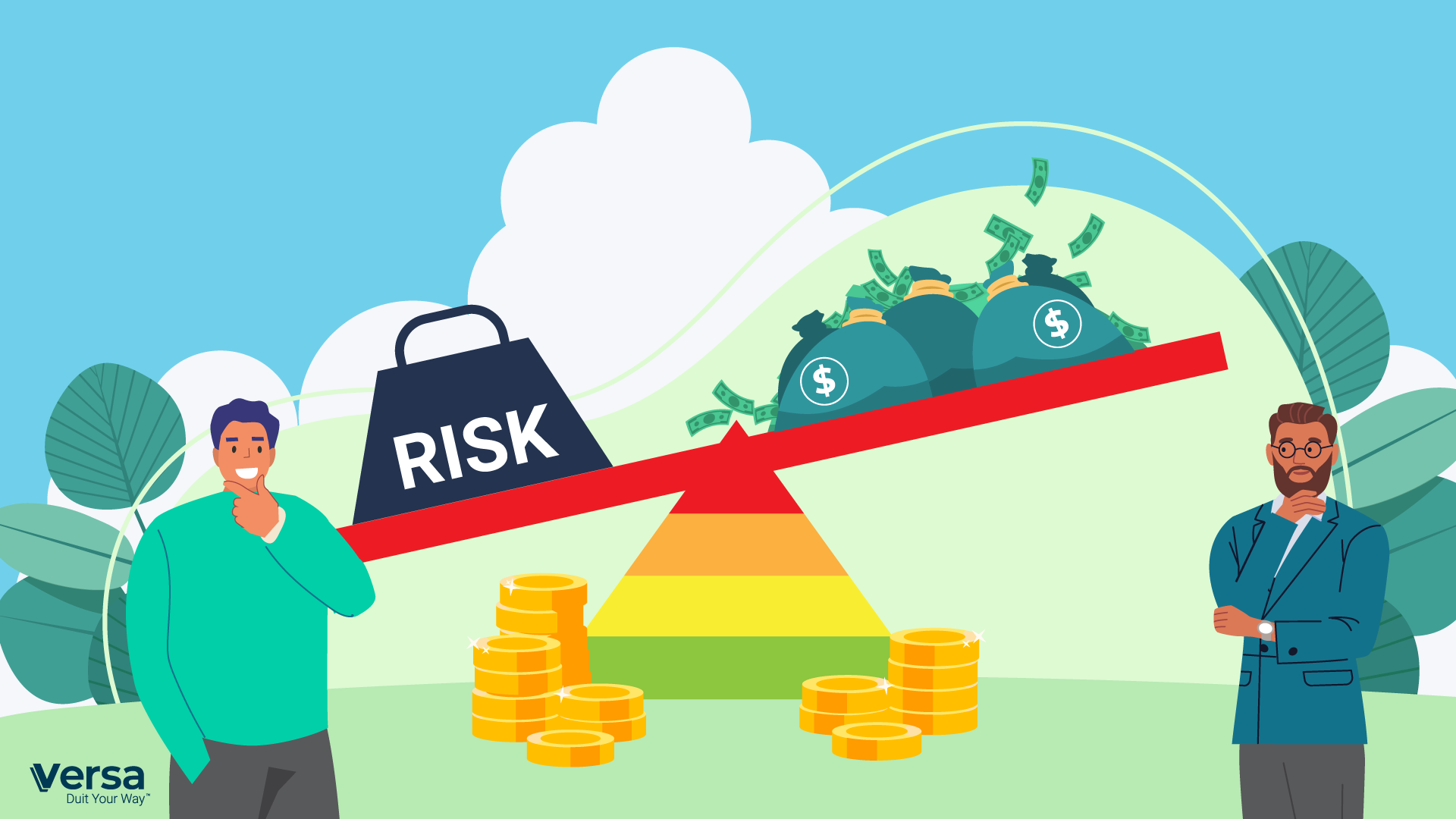

When going into investing, you want to know how much risk you can handle. This helps you decide on which investments are the right ones for you. Imagine it like choosing a meal. You don’t want to pick one that is too small or you’ll end up hungry. A big meal may leave you overwhelmed.
Thus, knowing how much risk you can handle when investing is called your risk appetite.
Your risk appetite reflects not only your preferences, it also considers your life situation and your goals.
So let’s dive into each aspect of your risk appetite and how each helps you decide on how much risk you can take.
In this article
- Your current status can track your risk appetite
- Know your financial goals to determine your risk appetite
- Pinpoint your risk tolerance to gauge your risk appetite
Your current status can track your risk appetite
Your age
Who says age is just a number?
The younger you are, the more risks you can take. Compared to someone in their 50s, your portfolio has time to recover from any short-term losses. Portfolios with higher risks will also yield higher returns. Since you have time to weather short-term ups and downs in the market, you have an advantage. However, consider other factors as well such as your financial status, goals and the type of job you have.
Your job
Your risk appetite also relies on what your job is. Is your income unsteady or involves high risk?
This applies to jobs that involve risk and uncertain income, such as business owners or gig workers. Without a fixed income, you need to consider taking a lower level of risk for your portfolios. The best way forward in those circumstances is to set aside a portion of your savings to be invested in more conservative investments.
Know your financial goals to determine your risk appetite

When it comes to deciding your financial goals, the first step is to understand your cash flow needs. Ask yourself: do you need your money anytime between a month – a year (short term) or can you wait beyond a year (long term)?
Next, assign different functions to these time frames. This will help you identify the best investment tools to meet your goals. Let’s look into how we can do this effectively.
Short term goals
A simple way to determine if your goal is short term is to see how soon you need to access your cash. This includes daily use, emergency expenses, setting up a sinking fund (e.g. gadgets, travel etc). The closer the time frame you need it, the more likely it is to be a short term goal.
Short term goals need low risk investments as they need to be achieved within a short period of time. Stocks or mutual funds, which tend to fluctuate greatly, may not give you the return you need in the short term. On the other hand, if you want to earn higher returns with higher risk, you can continue to invest in stocks. The trick is knowing when to sell and cut loose if anything happens to mitigate more risk according to your risk appetite.
If you are not comfortable taking risks, you can select low risk investments such as Versa Cash. Not only does Versa offer high liquidity, it yields higher returns than typical Fixed Deposits.
By optimizing your short term goals, it also helps with your long term planning.
Long term goals
Long term goals usually look at the bigger picture. In the long term, people usually plan for their retirement or children’s education. More time gives more flexibility. You can invest in growth assets – which tend to fluctuate more but produce higher returns over time. Since you have time to weather short-term ups and downs in the market, the risk is lessened.
Once you approach the time where you need your money, switch to more conservative investments. This way, you reduce the risk and meet your goals on time.
Pinpoint your risk tolerance to gauge your risk appetite
The final aspect of your risk appetite is your risk tolerance. Basically, how much are you comfortable to risk?
Ask yourself, how much losses can you accept? Will you be comfortable with a 30% loss and holding that until it recovers? Or are you emotionally tied to your investments which may make you want to reconsider the level of risk you want to take. The last thing you want is your investments to affect your emotional and mental wellbeing.
Just because your current status and types of goals mean that you can take on higher risk, you don’t have to. It just means that you can invest in less conservative portfolios.
Investing may involve risk; but at the end of the day, it is a tool to meet your goals and offer a peace of mind for your future.
Understanding your risk appetite helps you choose the right investment portfolio
Once you understand your risk appetite, the next step is to find the right investment. It may be overwhelming at first, which is why you can consider getting an already well-established portfolio managed by fund managers. This is where Versa Invest comes in. Before choosing your portfolio, we help you understand your risk appetite by having you answer a series of specially curated questions in our Suitability Assessment Test (SAT).
Versa Invest offers two portfolios of varying risks, giving you the flexibility to choose the risks you’re comfortable with. With global fund managers handling your portfolio, you can put your worries to rest.